ENGINEERING EXCELLENCE
Why Global Industry is Upgrading to Next-Gen Inverter TIG Systems
In high-precision fabrication sectors—such as nuclear piping, aerospace component production, sanitary food-grade stainless steel processing, and titanium heat exchanger fabrication—welding integrity leaves zero margin for defect. Traditional heavy transformer-rectifier units, while historically resilient, consume excessive electrical power, demonstrate sluggish dynamic arc response, and generate severe harmonic distortion on industrial microgrids.
The modern Inverter TIG Welder Series engineered by Parag Electrodes Agencies Pvt. Ltd. (Paragweld) represents a pivotal technological leap. Utilizing high-frequency Insulated Gate Bipolar Transistors (IGBTs) switching at frequencies up to 20kHz–50kHz, our TIG welding platforms convert 3-phase AC mains input into smooth, tightly controlled DC or synthesized AC output waveforms. This results in unprecedented arc stability, micro-second thermal input regulation, and up to 35% reduction in electrical power consumption.
1. Comprehensive Inverter TIG Welder Series Lineup & Technical Selection
Global procurement directors and shop-floor welding engineers frequently ask: "Which Inverter TIG power source architecture optimizes joint penetration depth while minimizing heat-affected zone (HAZ) grain growth across thin stainless steel sheets versus heavy aluminum structures?" Below is Paragweld’s curated series recommendation tailored for industrial applications.
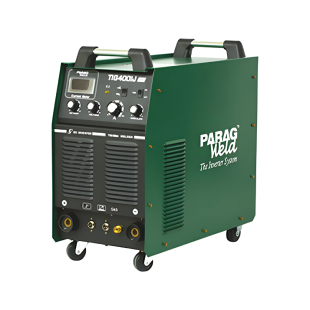
Heavy Industrial Flagship Paragweld TIG-400IJ Inverter AC/DC TIG Welder
Engineered for multi-shift heavy fabrication plants, the TIG-400IJ incorporates dual-module IGBT technology capable of delivering 400 Amperes at 60% rated duty cycle (40°C ambient). Features fully adjustable AC square wave frequency, cleaning balance control, and pulse frequency up to 200Hz.
Rated Input Voltage: 3-Phase 415V ±15%, 50/60Hz
Current Output Range: 10A – 400A (TIG / MMA)
Pulse Frequency Range: 0.5 Hz – 200 Hz
AC Balance Adjustment: 20% – 80% Cleaning Width
Arc Ignition: HF High-Voltage & Lift-Arc Modes
Compatible Materials: Aluminum, SS, Carbon Steel, Titanium
Inquire Now 
Compact High-Efficiency Series Paragweld TIG-315P Pulse Inverter TIG Machine
Designed specifically for precision pipe welding root passes, stainless steel pressure vessel liners, and sheet metal fabrication. The digital microprocessor pulse controller enables pinpoint heat input regulation, suppressing burn-through on thin-gauge materials while maintaining 315A power reserves.
Rated Power Input: 12.8 kVA
Duty Cycle (40°C): 60% @ 315A / 100% @ 244A
Down-Slope Time: 0 – 10 Seconds Adjustable
Gas Pre-flow / Post-flow: 0.1s – 15s Programmable
Power Factor: ≥ 0.93 (PFC Optimized)
Protection Rating: IP21S / Class H Insulation
Inquire Now 
Thermal Management Ecosystem Paragweld Heavy-Duty Liquid Circulation Cooling Unit
Continuous high-amperage TIG welding requires dedicated torch thermal protection. Paragweld’s stainless-steel-lined closed-loop water cooling units integrate seamlessly with our Inverter TIG Welder Series, preventing torch lead overheating, extending collet life, and maintaining stable gas lens flows during continuous 24/7 manufacturing operations.
Tank Capacity: 10 Liters Stainless Steel Reservoir
Max Pressure: 0.3 MPa (3 Bar)
Cooling Capacity: 1.5 kW @ 8L/min Flow Rate
Pump Motor: High-Torque Italian Pattern Brass Impeller
Inquire Now 2. Global Procurement Evaluation: Technology Comparison Matrix
When evaluating capital expenditure (CAPEX) against operating expenditure (OPEX), industrial procurement managers must assess energy consumption, duty cycle thermal derating, and process versatility. The table below presents an empirical engineering comparison between traditional welding equipment and Paragweld’s Inverter TIG Welder Series.
| Technical Metric / Evaluation Criteria | Legacy Heavy Transformer TIG | Paragweld Inverter TIG Welder Series | Fiber Laser Welding Systems |
| Electrical Energy Efficiency (η) | 50% – 62% (High Idle Losses) | 85% – 92% (IGBT PFC Switchgear) | 40% – 50% (High Chiller Load) |
| Power Factor (Cos φ) | 0.60 – 0.70 Lagging | 0.93 – 0.98 Energy-Efficient | 0.85 – 0.90 |
| Equipment Footprint & Weight | Heavy (> 180 kg), Non-Portable | Compact (28 kg – 48 kg), Highly Mobile | Very Large System Footprint |
| AC Waveform Balance Tuning | Fixed 50Hz Sine Wave (Uncontrolled) | 20Hz – 250Hz Square / Triangular / Sine Wave | N/A (Non-Arc Process) |
| Thin-Sheet Thermal Distortion | High HAZ, Distortion Common | Minimal HAZ (Ultra-High Pulse Control) | Extremely Low HAZ |
| Initial Capital Cost (CAPEX) | Moderate | Optimal / High ROI Factor | Extremely High ($40k - $120k+) |
| Consumables & Maintenance Cost | Low Maintenance, High Energy Bill | Low Maintenance, Very Low Energy Bill | Extremely Expensive Optics & Gas |
3. Technological Trends & Future Procurement Outlook for Industrial TIG Systems
As global manufacturing shifts toward Industry 4.0 standards, environmental sustainability directives (such as EU Ecodesign ErP directives), and automated robotic cell integration, the procurement parameters for industrial welding power sources are undergoing a fundamental transformation. B2B buyers must align their machinery orders with the following four key macro trends:
Trend A: Digital Microprocessor Waveform Control & AI-Assisted Arc Tuning
Modern aerospace and nuclear fabrication demands total repeatability in heat input. Advanced Inverter TIG Welder Series models are migrating from analog potentiometer controls to 32-bit ARM digital signal processors (DSPs). This allows precise tuning of AC wave shapes:
- Advanced Square Wave: Delivers maximum cleaning action and deep penetration for thick aluminum plates.
- Soft Sine Wave: Mimics traditional transformer arc fluidity while drastically reducing audible arc noise in enclosed structural workshops.
- Triangular Wave: Minimizes total heat input during pulse peak, enabling distortion-free welding of ultra-thin 0.5mm stainless steel bellows and medical tubing.
Trend B: Strict Energy Efficiency Norms & Active Power Factor Correction (PFC)
With rising electricity tariffs and stringent carbon footprint audits across European, North American, and Asian industrial zones, legacy welders with power factors below 0.70 are incurring substantial utility penalty surcharges. Paragweld’s next-generation Inverter TIG Welder Series integrates active PFC circuitry, accepting wide input line voltage fluctuations (320V to 460V 3-phase) while ensuring full operational output and maintaining a power factor above 0.93.
Trend C: Integration with Automated Robotic Cells and Orbital Weld Heads
Manual TIG welding requires exceptional human dexterity, but growing skilled welder shortages worldwide are driving automated cell adoption. Procurement trends indicate a 40% year-over-year surge in demand for Inverter TIG power sources equipped with digital communication protocols (CANopen, Modbus RS485, and 0–10V analog interfaces). Our TIG-400IJ architecture supports direct interface integration with industrial robots, automated seam trackers, and mechanized orbital pipe welding systems.
Trend D: Transition to Green Shielding Gas Formulations & Micro-Flow Controls
Cost minimization strategies are focusing heavily on shielding gas usage (Argon / Helium mixtures). Modern inverter units incorporate digital solenoid control valves with pre-flow, post-flow, and spot-welding timer micro-adjustments down to 0.01-second increments. This prevents argon gas waste, saving medium-to-large fabrication plants thousands of dollars annually in gas procurement costs.