Executive Procurement Briefing: The Evolution of Industrial MIG Welder Series
In modern industrial fabrication, heavy engineering, shipbuilding, and pressure vessel manufacturing, selecting an Industrial MIG Welder Series is no longer a simple matter of choosing amperage ratings. As global manufacturing transitions toward high-speed deposition, strict non-destructive testing (NDT) standards, and stringent energy efficiency targets, procurement teams must evaluate welding machinery through the combined lens of electrical architecture, dynamic arc stability, thermal endurance, and lifecycle operational cost.
Modern Gas Metal Arc Welding (GMAW) and Flux-Cored Arc Welding (FCAW) systems must deliver consistent weld bead geometry, zero-defect penetration, and minimal spatter across continuous multi-shift operations. Traditional transformer-rectifier power sources, while historically rugged, are rapidly being phased out worldwide due to their high electrical idle losses, poor power factor (<0.70), and limited arc control response times. In contrast, advanced 3-phase IGBT (Insulated Gate Bipolar Transistor) inverter-based MIG series—such as the flagship models manufactured by Paragweld (Parag Electrodes Agencies Pvt. Ltd.)—operate at switching frequencies exceeding 20 kHz to 40 kHz. This enables microsecond-level arc correction, reducing thermal distortion while increasing wire deposition rates by up to 35%.
Key Technical Takeaway for Global Sourcing Managers
When evaluating an Industrial MIG Welder Series for structural steel, heavy machinery, or forging die maintenance, the key metric is not peak current alone, but True Industrial Duty Cycle at 40°C Ambient Temperature. A machine rated at 500A @ 60% duty cycle allows continuous high-amp output without thermal shutdown, reducing downtime in intensive fabrication environments.
Flagship Product Recommendations: Paragweld Industrial MIG Series Matrix
For over four decades, Paragweld has engineered heavy-duty welding equipment engineered for aggressive industrial environments. Below are the primary recommendations within our industrial MIG welder range, designed to cover applications from medium sheet fabrication to continuous heavy-plate structural joining.
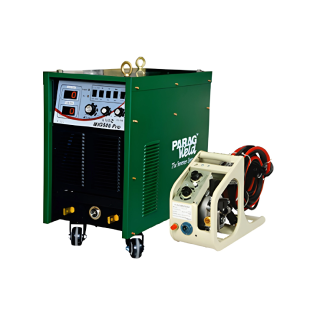
Industrial MIG Welder MIG-500 PRO
Primary Application: Heavy Steel Structures, Shipbuilding, Pressure Vessels, Forging Die Reclamation.
- Power Supply: 3-Phase AC 415V ± 15%, 50/60Hz
- Rated Output Current: 50A – 500A Continuous
- Duty Cycle: 60% @ 500A / 100% @ 388A (40°C)
- Wire Diameter Range: Ø 1.0mm, 1.2mm, 1.6mm Solid & Flux-Cored Wire
- Feeder Mechanism: Heavy-Duty 4-Roll All-Metal Geared Drive Unit
Contact Us for Custom Quote
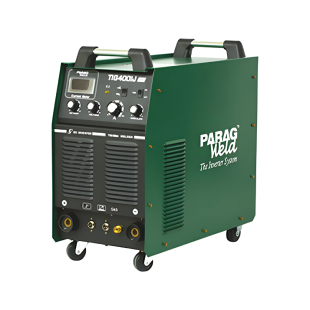
Multi-Process Inverter MIG-350 IJ
Primary Application: Automotive Components, General Machinery, Stainless Steel Fabrication, Machine Shops.
- Power Supply: 3-Phase AC 415V ± 15%, 50/60Hz
- Rated Output Current: 40A – 350A
- Duty Cycle: 60% @ 350A / 100% @ 270A
- Wire Diameter Range: Ø 0.8mm, 1.0mm, 1.2mm
- Core Technology: High-Efficiency Synergic Waveform Inverter Control
Contact Us for Specifications
Comparative Technical Architecture: Industrial MIG Series Breakdown
To assist technical procurement teams in selecting the exact inverter configuration, the following comparative engineering table highlights key physical and operational parameters across the Paragweld Industrial MIG Welder Series:
| Model Parameter | MIG-350 PRO | MIG-500 PRO (Flagship) | MIG-630 HEAVY DUTY |
|---|---|---|---|
| Input Voltage (V) | 3-Phase 415V ± 15% | 3-Phase 415V ± 15% | 3-Phase 415V ± 15% |
| Rated Input Capacity (kVA) | 14.0 kVA | 24.5 kVA | 35.0 kVA |
| Current Range (A) | 40A – 350A | 50A – 500A | 60A – 630A |
| Duty Cycle (40°C Ambient) | 60% @ 350A / 100% @ 270A | 60% @ 500A / 100% @ 388A | 100% @ 500A / 60% @ 630A |
| Wire Diameter Compatibility | 0.8 / 1.0 / 1.2 mm | 1.0 / 1.2 / 1.6 mm | 1.2 / 1.6 / 2.0 mm |
| Wire Feed System | 2-Roll / 4-Roll Geared | 4-Roll Heavy Duty Metal Drive | 4-Roll Water-Cooled Dual Drive |
| Gouging Capability | N/A | Integrated (up to 8mm carbon) | Heavy Duty Carbon Gouging (10mm) |
| Insulation Class / Protection | Class H / IP23S | Class H / IP23S | Class H / IP23S |
Engineering Insights: Arc Dynamics, Waveform Control & Thermal Management
The operational excellence of an industrial MIG welder relies heavily on how the power source handles droplet transfer transitions between short-circuit, globular, and spray arc modes. High-amperage industrial MIG welding requires precise regulation of inductance and electronic wave control to prevent excessive spatter, incomplete root penetration, and undercut defects.

1. Microprocessor-Driven Electronic Inductance Adjustment
Traditional constant-voltage (CV) MIG power sources relied on heavy iron-core chokes to alter the rate of current rise during short-circuit transfer. Paragweld’s MIG-500 PRO Series utilizes closed-loop digital feedback logic that adjusts current slope dynamics in real-time. By fine-tuning the electronic inductance knob, operators can transition from a "soft" arc (ideal for thin sheet metal with minimal spatter) to a "stiff" arc (essential for deep penetration on heavy carbon steel plates and root pass welding).
2. 4-Roll Geared Wire Feeding Dynamics
A frequent point of failure in low-cost commercial MIG welders is wire feeding stutter, which causes arc instability, burnback, and contact tip fusing. The Paragweld Industrial MIG Series features an independent heavy-duty 4-roll wire feeder powered by a high-torque DC servo motor. Encased in a cast-aluminum housing, the dual-geared drive rollers ensure smooth, slip-free feeding of both hard carbon wires and soft aluminum wires, even through 10-meter push-pull or inter-connecting cable assemblies.
3. Advanced Thermal Dissipation Architecture
Industrial environments in regions like the Middle East, Southeast Asia, and India often experience ambient factory temperatures exceeding 40°C to 45°C. Paragweld MIG welders are engineered with an isolated wind path structure (Tunnel Cooling Design). High-heat electrical components—such as IGBT modules, ultra-fast recovery diodes (FRED), and high-frequency transformers—are positioned in a dedicated cooling channel. Sensitive control PCBs are sealed separately to prevent metallic dust accumulation, board corrosion, and short-circuits.
Future Technological Trends in Industrial MIG Welding (2025–2030)
As global manufacturing shifts toward smart factories, carbon footprint reduction, and skilled labor shortages, the technological landscape of MIG welding machines is undergoing a profound transformation. Sourcing officers and operations engineers must anticipate these emerging trends when investing in capital equipment today:
Trend A: Synergic Digital Control & AI-Assisted Weld Parameter Presets
The reliance on veteran, highly experienced welder operators is becoming a major challenge for fabrication yards globally. Future-ready MIG welder series are integrating Synergic Digital Microprocessors. With a single control knob input (selecting plate thickness, wire material type, and gas mixture), the machine automatically calculates optimal voltage, wire feed speed, and peak pulse current. This reduces setup times by up to 70% and minimizes operator error during high-spec code welding.
Trend B: Ultra-Low Energy Loss via Active PFC Inverters
Energy tariffs are a significant component of total operational expenditure in continuous heavy manufacturing. Modern industrial MIG welders are adopting Active Power Factor Correction (PFC) technology. PFC raises power factor performance to >0.95 and allows machines to operate reliably across fluctuating input voltages (320V to 460V), protecting internal components against generator voltage spikes in remote field projects.
Trend C: High-Speed Pulse MIG and Double-Pulse for Exotic Alloys
While traditional short-circuit MIG is limited to flat/horizontal positions on thick materials due to cold-lap risk, advanced Pulse MIG Technology alternates between high peak current (detaching a single droplet without spatter) and low background current (cooling the weld pool). Double-Pulse MIG further mimics the aesthetic TIG ripple profile on aluminum and stainless steel structures while delivering 4x faster travel speeds.
Trend D: Cobot & Robotic Automation Readiness
Automated manufacturing lines require seamless digital integration between welding power sources and robotic arms. Modern Paragweld MIG series include standardized analog and digital communication ports (RS485, CANbus, and 0-10V analog interfaces) for rapid retrofitting onto welding positioners, linear seamers, and articulated robotic cells.
Global B2B Procurement Trends: Sourcing Strategy & TCO Analysis
Global procurement metrics show a decisive shift in how international EPC contractors, manufacturing conglomerates, and industrial distributors source welding machinery from primary manufacturing hubs like India.
Evaluating Total Cost of Ownership (TCO) vs. Initial Purchase Price
Smart procurement executives no longer base vendor decisions solely on initial machine unit cost. A comprehensive Total Cost of Ownership (TCO) calculation incorporates four critical dimensions over a 7-year machinery operational lifespan:
- Electrical Consumption Efficiency: High-frequency IGBT inverters yield up to 30% power savings compared to aging step-transformer welders.
- Consumable & Wear-Part Longevity: Controlled arc dynamics extend the working life of contact tips, gas diffusers, and torch liners by reducing spatter adhesion.
- Downtime Mitigation: Modular internal layout and off-the-shelf standard torch consumables (e.g., Euro-connect MB36KD / MB501D styles) ensure rapid field repair without waiting weeks for proprietary vendor components.
- Factory-Direct Technical Support: Direct collaboration with original equipment manufacturers (OEMs) guarantees access to original spare parts, custom wiring looms, and expert technical guidance.
Frequently Asked Questions (FAQ) by Global B2B Buyers & Engineers
Below are detailed, expert answers to the most common technical questions asked by procurement managers, welding inspectors, and factory buyers when sourcing an Industrial MIG Welder Series:
For heavy structural fabrication, pressure vessels, and multi-shift manufacturing, a minimum 60% duty cycle at maximum rated amperage (e.g., 500A) and 100% duty cycle at 380A–400A (tested at 40°C ambient temperature according to IEC 60974-1 standards) is required. A 100% duty cycle at 388A means the machine can weld continuously non-stop without overheating, which is essential for thick-plate automated or semi-automated seams.
3-Phase IGBT inverter welders convert incoming 50/60Hz AC power into high-frequency AC (above 20 kHz) before rectifying it to DC output. This results in three major advantages: 1) Energy Efficiency: Saves up to 30-35% electricity; 2) Microsecond Arc Response: Provides superior puddle control with virtually zero spatter; 3) Size & Weight Reduction: Inverter transformers weigh a fraction of traditional copper-wound step transformers, making shop relocation significantly easier.
Solid wire (GMAW) requires clean joint surfaces and external shielding gas (100% $CO_2$ or $Ar/CO_2$ blends) and is preferred for clean shop fabrication. Flux-cored wire (FCAW) contains internal fluxing agents that form a protective slag layer over the molten pool. FCAW allows higher deposition rates, deeper penetration on dirty/rusty steel, and can be run gasless (self-shielded) or with gas-shielding (dual-shield). Paragweld MIG-500 PRO series features dedicated voltage-current slope settings optimized for both solid and flux-cored wire types.
Air-cooled MIG torches rely on ambient air and shielding gas flow for cooling; they are lightweight and suitable for intermittent welding up to 300A–350A. However, when welding continuously at current levels above 350A–500A, torch handle heat becomes unbearable for operators, and contact tip degradation speeds up dramatically. A Water-Cooled Torch paired with an Industrial Water Cooling Unit circulates coolant directly through the torch neck, extending consumable life by 3x and allowing comfortable 100% continuous duty welding at high amperages.
Using 100% $CO_2$ shielding gas provides deep "finger-like" penetration and is low-cost, but generates higher spatter levels and a harsher arc. Mixing Argon with $CO_2$ (typically 80% Ar / 20% $CO_2$ or 85% Ar / 15% $CO_2$) smooths droplet transfer into a spray arc mode, dramatically reduces spatter, improves bead appearance, and reduces post-weld grinding labor costs by up to 50%.
Paragweld Industrial MIG Welders incorporate comprehensive safety systems: Under-Voltage/Over-Voltage Protection (±15% tolerance), Thermal Overload Sensors on primary IGBT heatsinks and main transformers, Over-Current Circuit Breakers, and Phase Loss Protection. Printed Circuit Boards are coated with tropicalized anti-moisture, anti-dust conformal varnish to withstand high-humidity coastal and dusty industrial environments.
Every industrial welding machine manufactured by Parag Electrodes Agencies Pvt. Ltd. undergoes rigorous quality assurance testing compliant with ISO 9001:2015 Quality Management Systems and standard electrical safety guidelines (EN/IEC 60974-1). Load bank testing for full rated amperage is conducted on 100% of production units prior to export packaging.
We maintain comprehensive spare parts inventory (including control mainboards, driver boards, IGBT modules, wire feeder assemblies, and torch consumables). For international customers, we provide direct video technical consultation with our senior electrical engineers, detailed schematics, modular drop-in replacement boards, and rapid dispatch of spare parts via express global logistics channels.
Manufacturer E-E-A-T & Enterprise Infrastructure: Why Partner with Paragweld
Establishing a long-term sourcing partnership requires complete confidence in the manufacturer's operational history, engineering background, and technical capability. Parag Electrodes Agencies Pvt. Ltd. (Paragweld) has been a cornerstone of India's industrial welding manufacturing sector for over four decades.

Established in 1980 by Mr. Parag Mashruwala in the heart of GIDC Vatva, Ahmedabad, Gujarat, the enterprise originated with a single-minded commitment to manufacturing high-grade welding electrodes and heavy machinery. Over 44+ years of continuous innovation, the company expanded its manufacturing footprint to encompass full-spectrum industrial arc welding solutions—including Submerged Arc Auto Welders (MZ-1250 Series), Inverter TIG Welders, Heavy Duty ARC Welders, LGK Air Plasma Cutters, and the premier Industrial MIG Welder Series.
Today, Paragweld operates state-of-the-art testing laboratories, assembly lines, and burn-in stations in Ahmedabad. Serving over 5,000 corporate clients across 30+ countries, our equipment is deployed in forge shops, steel rolling mills, offshore fabrication yards, railway coach building facilities, and heavy machine shops. Our strategic membership in the Gujarat Chamber of Commerce & Industry (GCCI) and long-standing distribution partnerships for premium consumables reinforce our standing as a trusted partner for global B2B buyers.
Ready to Upgrade Your Industrial MIG Welding Fleet?
Work directly with Paragweld’s application engineers to determine exact machine sizing, wire feeder configurations, and custom torch setups tailored to your production lines.