1. Technical Fundamentals: Demystifying the Commercial Submerged ARC Auto Welder
In the arena of heavy industrial metal fabrication, the Commercial Submerged ARC Auto Welder (SAW) stands as the uncontested benchmark for high-volume, deep-penetration, defect-free longitudinal and circumferential seam joining. Unlike manual Shielded Metal Arc Welding (SMAW) or semi-automatic Gas Metal Arc Welding (GMAW), the Submerged Arc process functions by establishing an electric arc between a continuously fed solid or cored electrode wire and the metallic workpiece, completely submerged beneath a granular, fusible mineral flux envelope.
This blanketing layer of granular flux serves three crucial metallurgical and operational functions:
- Atmospheric Isolation & Zero Arc Glare: The molten weld pool and arc zone are completely isolated from atmospheric oxygen, nitrogen, and hydrogen contamination. Because the arc burns silently beneath the flux burden, operators are not exposed to intense ultraviolet (UV) radiation or heavy open-arc smoke, making it safer for continuous production environments.
- Thermal Insulation & Slow Cooling Rates: The slag cover acts as a high-performance thermal blanket. By retarding the weld pool cooling rate, it allows trapped hydrogen gases to escape, virtually eliminating Hydrogen-Induced Cracking (HIC) and cold cracking risks in high-tensile structural steels (e.g., ASTM A572 Grade 50, S355JR, or ASME SA516 Gr 70).
- Metallurgical Deoxidation & Alloy Addition: Engineered fluxes chemically react with the liquid metal, removing impurities while precisely introducing manganese, silicon, and molybdenum to match the parent metal's mechanical yield strength and Charpy V-Notch impact toughness down to -40°C.
💡 Information Gain Insight: Current Density & Deposition Efficiency
A key technical differentiator of a Commercial Submerged ARC Auto Welder is its ultra-high current density. Because wire stick-out (electrical extension) is tightly controlled inside an automated tractor carriage, current densities can reach up to 150 A/mm²—more than three times that of SMAW electrodes. This translates into deposition rates exceeding 12 to 20 kg/hour per wire head, reducing pass counts on heavy thick-wall plates (over 25mm thickness) by up to 70%.
2. Commercial Submerged ARC Auto Welder Product Recommendations
Selecting the correct SAW configuration depends heavily on plate thickness, joint geometry, duty cycle requirements, and mobility demands. Below are the flagship Commercial Submerged ARC Auto Welder systems engineered by Paragweld, alongside complementary industrial equipment for integrated fabrication lines.
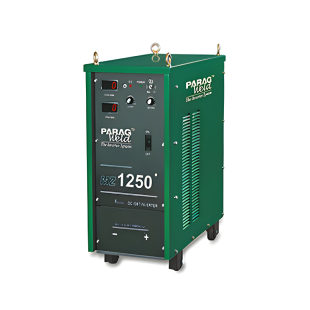
Submerged ARC Auto Welder MZ-1250
Primary Application: Heavy Structural Beams, Pressure Vessels, Wind Towers, Ship Hull Seams.
The MZ-1250 is Paragweld's flagship heavy-duty automatic submerged arc welding system. Driven by an advanced IGBT inverter power source, it offers dual Constant Current (CC) and Constant Voltage (CV) modes with a full 1250-Amp output at 100% duty cycle. Features digital closed-loop tractor carriage speed control, automated wire feed, and integrated flux hopper feed.
Key Specs: 200–1250A range, 2.0–6.0mm wire diameter, 100% duty cycle @ 40°C.
Get a Quote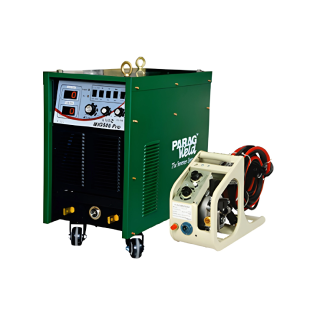
Industrial MIG Welder MIG-500 PRO
Primary Application: Root-Pass Tack Welding, Fit-up Preparation & Medium Fabrication.
Before deploying a Commercial Submerged ARC Auto Welder, robust root-pass tacking is mandatory. The MIG-500 PRO provides stable low-spatter GMAW/FCAW arc performance, perfect for sealing plate gaps and preparing heavy joint bevels prior to submerged arc capping passes.
Key Specs: 500A rating, heavy-duty 4-roll wire feeder, wave control technology.
Get a Quote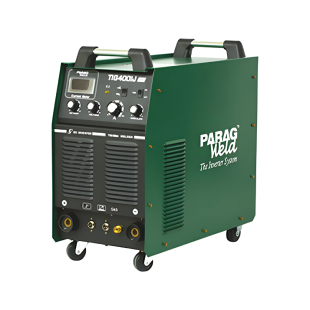
Inverter TIG Welder TIG-400IJ
Primary Application: High-Precision Pipe Root Welding & Alloy Cladding.
When working on high-pressure boiler tubes or nuclear piping, fabricators use the TIG-400IJ to lay down an ultra-clean, radiographic-quality TIG root pass before filling and capping the thick joint with the Commercial Submerged ARC Auto Welder.
Key Specs: High-frequency arc ignition, pulse controls, 400A digital output.
Get a Quote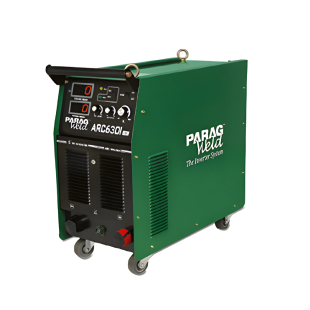
Heavy Duty ARC Welder ARC-630i
Primary Application: Carbon Arc Gouging, Back-Gouging & Site Repair.
Deep double-V joints welded with a Commercial Submerged ARC Auto Welder require clean back-gouging on the reverse side. The ARC-630i inverter power source provides brute-force current output for carbon arc gouging to eliminate root flaws before final SAW backing passes.
Key Specs: 630A continuous gouging capability, anti-stick, heavy duty rugged design.
Get a QuoteLGK Air Plasma Cutter & Auxiliary Edge Preparation Systems
Clean bevel preparation is crucial for Commercial Submerged ARC Auto Welders. Pair your SAW system with Paragweld's LGK Air Plasma Cutter Series 200 for precision high-speed bevel cutting up to 50mm plate thickness.
3. Engineering Specifications Matrix: Commercial SAW Models
To aid global procurement managers, welding engineers, and quality directors in selecting the precise Commercial Submerged ARC Auto Welder, the table below provides a comprehensive comparison of technical metrics across standard industrial configurations.
| Technical Parameter | MZ-1000 Standard SAW | MZ-1250 Heavy Duty SAW | Tandem Wire SAW-1600 | Tractor Portable SAW-800 |
|---|---|---|---|---|
| Input Voltage (V / Hz) | 3-Phase AC 415V ±15%, 50/60Hz | 3-Phase AC 415V ±15%, 50/60Hz | 3-Phase AC 415V ±15%, 50/60Hz | 3-Phase AC 415V ±15%, 50/60Hz |
| Rated Input Capacity (kVA) | 52 kVA | 70 kVA | 95 kVA | 40 kVA |
| Output Current Range (A) | 160 – 1000 A | 200 – 1250 A | 250 – 1600 A (Combined) | 100 – 800 A |
| Duty Cycle Rating (40°C) | 100% @ 1000A | 100% @ 1250A | 100% @ 1600A | 100% @ 800A |
| Applicable Wire Diameter (mm) | Ø 2.0 – 5.0 mm | Ø 2.5 – 6.0 mm | Dual Ø 2.5 / 4.0 mm | Ø 1.6 – 3.2 mm |
| Tractor Travel Speed (m/hr) | 15 – 90 m/hr | 15 – 120 m/hr | 20 – 150 m/hr | 10 – 80 m/hr |
| Flux Tank Capacity (L / kg) | 12 L / 18 kg | 16 L / 25 kg | 25 L / 40 kg (Dual Hopper) | 8 L / 12 kg |
| Wire Feeding Mechanism | Four-roll Heavy Drive | Four-roll Enclosed Servo Drive | Dual Independent Servo Drives | Two-roll Compact Drive |
| Power Source Architecture | IGBT Inverter (CC/CV) | Advanced IGBT Inverter (CC/CV) | Dual Inverter Synchronized | IGBT Inverter (CV Dominant) |
| Compliance Standards | ISO 9001, CE, AWS D1.1 | ISO 9001, CE, AWS D1.1, ASME IX | ISO 9001, CE, AWS D1.1, ASME IX | ISO 9001, CE |
4. Global Procurement Trends & Next-Gen SAW Developments
The global market for Commercial Submerged ARC Auto Welders is undergoing a profound transformation driven by digital manufacturing, stringent carbon audit requirements, and global shortage of certified master welders. B2B buyers evaluating equipment for 5-to-10-year capital expenditure (CapEx) cycles must align with the following emerging technological vectors:
A. Waveform Control & Inverter Power Efficiency
Legacy SAW machines relied on massive, power-hungry heavy transformer-rectifier units with low power factor ratings (typically 0.65 to 0.75). Modern commercial submerged arc auto welders, such as Paragweld's inverter-driven units, utilize high-frequency switching IGBT modules. This upgrade increases electrical efficiency up to 89–92% and raises power factor above 0.95, resulting in up to 30% electrical energy cost savings annually in continuous fabrication plants.
B. Real-Time Seam Tracking & Laser Vision Guidance
Next-generation commercial submerged arc auto welders are increasingly integrated with tactile mechanical or optical laser-guided seam tracking systems. As heavy plates experience thermal distortion during multi-pass welding, dynamic laser tracking adjusts the welding head position in X, Y, and Z axes in real time. This ensures 100% center-line penetration without requiring constant manual intervention by the tractor operator.
C. Integrated Vacuum Flux Recovery & Thermal Conditioning
Flux recycling is no longer optional—it is a critical economic and quality imperative. Modern SAW tractor units feature automated pneumatic vacuum recovery heads that pull un-melted granular flux straight back into the heated hopper. Maintaining flux at temperatures above 120°C prevents ambient moisture absorption, shielding high-strength alloy welds against hydrogen cracking while reducing total flux consumption by 35% to 45%.
D. Robotic Gantry & Column-and-Boom SAW Integration
While tractor-mounted commercial submerged arc auto welders dominate field fabrication and structural H-beam production lines, shop-based vessel fabricators are rapidly adopting column-and-boom (manipulator) automation. In these setups, the SAW head is mounted to a motorized boom that coordinates with heavy-duty workpiece turning rolls (rotators) to execute perfectly uniform circumferential girth welds on tanks, boilers, and monopiles.
5. Economic Analysis: Total Cost of Ownership (TCO) & ROI Calculation
When presenting a capital purchasing request for a Commercial Submerged ARC Auto Welder to executive leadership, procurement managers must quantify ROI beyond the initial machine purchase price. Submerged Arc Welding delivers unprecedented cost per meter advantages on heavy plate joinery.
📊 Economic Case Study: 25mm Carbon Steel Plate Longitudinal Joint (100 Meters)
Comparison: Manual SMAW (E7018) vs. Semi-Auto FCAW (E71T-1) vs. Commercial SAW (MZ-1250)
- Shielded Metal Arc Welding (SMAW): Requires ~18 passes. Total welding time: 42 hours. Labor & overhead cost high. Stub loss & deslagging time excessive.
- Flux-Cored Arc Welding (FCAW): Requires ~10 passes. Total welding time: 16 hours. High shielding gas costs ($/m³) and significant open-arc spatter cleanup.
- Commercial Submerged ARC Auto Welder (SAW): Requires only 2 to 3 passes (using suitable bevel design). Total welding time: 3.2 hours. Zero spatter, 98% wire deposition efficiency, 100% flux recovery efficiency.
Conclusion: A Commercial Submerged ARC Auto Welder reduces overall joint completion cost by up to 68% and pays for itself within 4.5 months of continuous duty.
6. Why Global Procurement Teams Source from Paragweld
Established in 1980 by Mr. Parag Mashruwala in GIDC Vatva, Ahmedabad, India, Parag Electrodes Agencies Pvt. Ltd. (Paragweld) has grown from a specialized electrode blending plant into a premiere international manufacturer and exporter of heavy industrial welding equipment.
🏭 Manufacturing Mastery & Infrastructure
Our state-of-the-art GIDC Vatva manufacturing unit houses modern assembly lines, thermal endurance testing bays, and precision transformer winding units. Every Commercial Submerged ARC Auto Welder undergoes a mandatory 24-hour continuous full-load heat run before dispatch.
🤝 Authorized Stockist Partnerships
Paragweld is a recognized authorized stockist for world-leading consumable brands including Modi Arc Electrodes and D&H Secheron, and an active member of the Gujarat Chamber of Commerce & Industry (GCCI). We supply matching flux-wire packages tailored to your specific metallurgy.
🌍 Global Export Footprint
With over 5,000 satisfied clients in 30+ countries across the Middle East, Southeast Asia, Africa, and Europe, our dedicated export team handles complete multimodal container shipping, export documentation, and customs clearing assistance.
🛠️ Lifetime Spare Parts & Technical Service
We maintain full inventory stocks of replacement control PCBs, tractor drive motors, flux hoppers, contact tips, and wire feed rollers. Our engineers provide remote diagnostic support and onsite commissioning worldwide.
7. Frequently Asked Questions (FAQ) for Commercial Submerged ARC Auto Welders
Addressing critical engineering, operational, and procurement queries frequently submitted by global B2B buyers and AI search users.
Authorised Stockist & Enterprise Partners