Knowledge Hub & Insights
Knowledge Hub & Insights
In modern structural steel fabrication, shipbuilding, pressure vessel construction, and cross-country pipeline engineering, the transition from manual shielded metal arc welding (SMAW) and semi-automatic GMAW to fully mechanized welding carriage tractors represents a fundamental shift in operational productivity. Welding carriages provide consistent linear travel speeds, precise torch positioning, and programmable weaving patterns that virtually eliminate human-error defects such as undercut, lack of fusion, and erratic heat input ($kJ/mm$).
Engineered by industry pioneers such as Parag Electrodes Agencies Pvt. Ltd. (Paragweld)—headquartered in GIDC Vatva, Ahmedabad, India since 1980—modern automated welding tractors integrate heavy-duty closed-loop PWM drives, rare-earth permanent magnet adhesion units, and digital weave controllers. This technical guide serves as an authoritative purchasing and engineering benchmark for industrial directors sourcing high-reliability welding carriages globally.
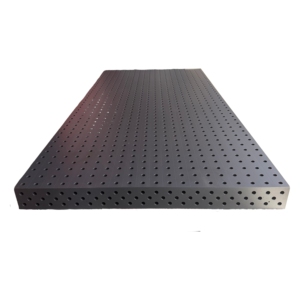
High-precision modular flexible welding platform engineered for automated carriage guidance, robotic cell positioning, and 2D/3D dimensional repeatability.
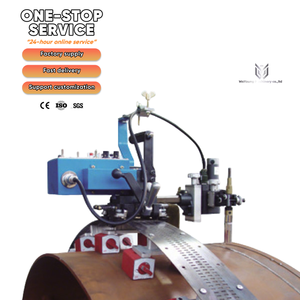
Automated 4-wheel drive tank welding cart engineered for continuous vertical and horizontal lap or fillet seam welding on oil storage tanks and pressure vessels.
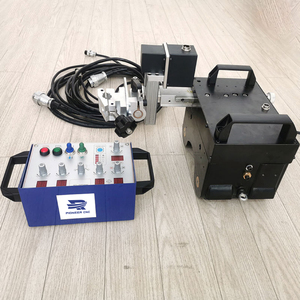
High-mobility trackless magnetic tractor adhering directly to ferrous carbon steel plates and pipe diameters (≥200mm OD) for seam execution without rigid rails.
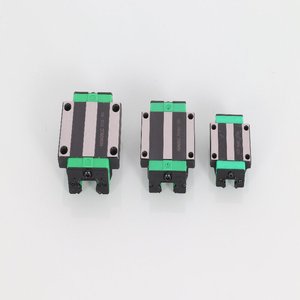
Precision linear rail carriage designed for integration into custom gantry welders, longitudinal beam lines, and high-speed plasma bevel cutting equipment.
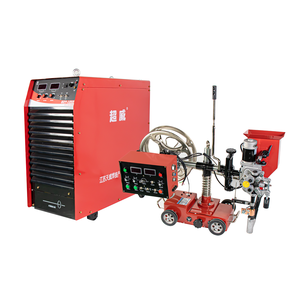
High-amperage submerged arc welding tractor equipped with 10L flux hopper, wire feed drive assembly, and heavy 4-wheel drive system for longitudinal structural welds.
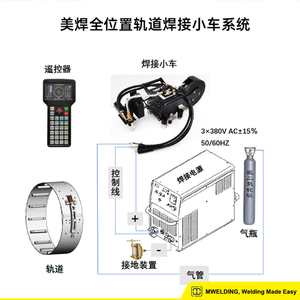
Specialized API 650 storage tank girth seam welder that rides along the upper rim of tank shells, providing double-sided automatic submerged arc circumferential welds.
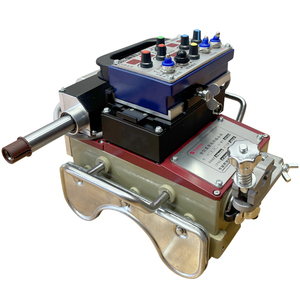
Universal 220V compact MIG/MAG automatic welding carriage featuring built-in linear oscillator, magnetic clutch release, and digital velocity readout.
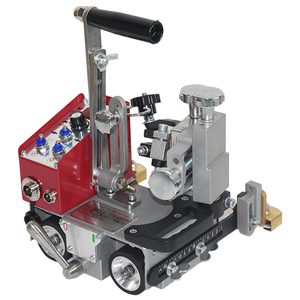
Lightweight aluminium chassis magnetic welding tractor designed for easy single-operator transport, high field reliability, and consistent fillet weld reinforcement.
Choosing the optimal automated welding tractor requires evaluating mechanical adhesion method, drive control accuracy, torch weaving capabilities, and process compatibility. The decision table below details key performance benchmarks for industrial engineering buyers.
| Carriage Type | Drive & Adhesion Mechanism | Speed Control Range | Vertical Climbing Cap. | Max Welding Process | Target Industrial Application |
|---|---|---|---|---|---|
| Trackless Magnetic Carriage | Rare-Earth Permanent Magnet + 4WD Rubber/Silicone Wheels | 100 - 1200 mm/min (PWM Closed-Loop) | Up to 90° on Ferrous Steel Plate (>5mm) | MIG/MAG (GMAW), FCAW (Flux-Cored) | Shipbuilding stiffeners, structural box girders, long flat fillet welds. |
| Rigid / Flexible Track Carriage | Gear-and-Pinion Steel/Alloy Track Drive | 50 - 1500 mm/min (Digital Stepper Motor) | 100% Vertical & Overhead (Constrained) | MIG/MAG, TIG (GTAW), Plasma Arc (PAW) | Spherical tanks, curved ship hulls, orbital pipe joints, 3D curved seams. |
| Heavy SAW Tractor | High-Torque All-Steel Gearbox 4WD Heavy Wheels | 100 - 1800 mm/min (Heavy DC Servo) | Flat & Inclined Horizontal Seams (≤15°) | Submerged Arc Welding (SAW Single/Tandem) | H-Beam production, thick pressure vessel longitudinal seams, API pipe mills. |
| Orbital Tank Girth Welder | Rim-Riding Guide Rollers + Counterweighted Carriage | 100 - 1600 mm/min (Frequency Inverter) | Continuous Horizontal Circumferential Rim | SAW, FCAW-GS Heavy Deposition | API 650 oil storage tanks, chemical silo circumferential field erection. |
Integration of real-time laser profile sensors onto carriage assemblies allowing autonomous compensation for thermal plate warping and joint gap fluctuations during live welding runs.
Transition toward high-capacity 36V/48V quick-swap lithium battery packs, eliminating dragging control cables in tight structural enclosures and reducing jobsite trip hazards.
Advanced digital microprocessors providing trapezoidal, sine, circular, and figure-8 torch weave paths with independent left/right dwell times for heavy-wall multi-pass pipe joints.
Carriages equipped with Wi-Fi/Bluetooth modules streaming instant travel speed, current ($A$), arc voltage ($V$), and heat input ($kJ/mm$) to cloud servers for EN ISO 15614 quality compliance.
Replacement of heavy carbon steel guide tracks with flexible extruded aerospace-grade aluminum and carbon-fiber track segments, reducing setup labor by over 40%.
Carriage frames modified to mount tandem MIG or Submerged Arc torches simultaneously, doubling metal deposition rates ($kg/hr$) without increasing thermal distortion.
Founded in 1980 by Mr. Parag Mashruwala in GIDC Vatva, Ahmedabad, India, Parag Electrodes Agencies Pvt. Ltd. (Paragweld) has evolved into a premier OEM exporter of heavy industrial welding machines, automatic tractors, and welding consumables.
Every welding carriage undergoes rigorous multi-stage quality control—including 48-hour continuous motor burn-in, magnet pull-force verification, and electromagnetic HF interference shielding tests—guaranteeing jobsite reliability.
Beyond welding carriages, Paragweld manufactures matching inverter power sources (MIG-500 PRO, TIG-400IJ, ARC-630i, Submerged Arc MZ-1250), heavy duty electrodes, and water cooling chillers for single-source procurement simplicity.
Serving over 5,000 corporate clients across 30+ countries throughout the Middle East, Southeast Asia, Africa, and Europe, Paragweld provides comprehensive technical guidance, spare parts availability, and custom OEM engineering solutions.
Trackless magnetic carriages rely on internal high-coercivity rare-earth permanent magnets to pull the chassis firmly against ferrous steel surfaces (≥5mm thickness), allowing 4-wheel rubber or silicone rollers to drive parallel to plate edges without external guide rails. Track-guided tractors, by contrast, use rack-and-pinion steel gears mounted on rigid or flexible aluminum tracks. Trackless systems offer faster setup for simple fillet welds, whereas track-guided systems are required for non-ferrous metals (stainless steel/aluminum), overhead positions, or complex 3D orbital geometries.
Heat input ($HI$) is calculated using the formula: $HI = \frac{V \times I \times 60}{\text{Travel Speed } (mm/min) \times 1000} \times \eta$ (where $\eta$ is process efficiency). Manual welding suffers from speed fluctuations of ±25%, causing hot spots or lack of fusion. Mechanized carriages feature closed-loop optical encoder feedback motors that maintain travel speed within a tight ±1% window. This precise speed control holds heat input strictly within the specified Metallurgical Procedure Qualification Record (WPQR), preserving tensile strength and Charpy V-notch impact toughness in high-strength low-alloy (HSLA) steels.
Standard magnetic carriages rely on ferromagnetic attraction and will not adhere to austenitic stainless steel (304/316 grade) or aluminum plates. For non-ferrous fabrication, procurement managers must select rigid aluminum track carriages featuring vacuum-suction cup mountings or mechanical clamping tracks. Alternatively, duplex stainless steels exhibiting partial ferromagnetism may work with high-power magnetic tractors, though pre-production adhesion testing is strongly recommended.
Spatter accumulation on magnetic assemblies and drive wheels is the primary cause of speed variation. Preventive maintenance includes installing high-temperature silicone rubber wheel covers, applying non-silicone anti-spatter sprays to carriage underbodies, and ensuring brass spatter scrapers are positioned ahead of the rollers. Additionally, magnetic units should feature sealed permanent magnet clusters with quick-release levers that allow operators to wipe away attracted iron dust at the end of every shift.
Jobsite diesel generators frequently suffer voltage spikes and drops (±15%). Industrial-grade welding carriages from top manufacturers incorporate wide-voltage SMPS (Switch Mode Power Supply) control boards capable of operating stably within AC 110V-240V (±15%) at 50/60Hz. Internal DC step-down transformers isolate motor control circuits from high-frequency (HF) arc-ignition interference generated by adjacent TIG welders or heavy plasma cutting machinery.
Torch weaving oscillates the welding arc laterally across the joint groove. Programmable weave parameters—specifically oscillation amplitude (0-30mm), weave frequency (0-100 Hz), and left/right sidewall dwell times—prevent undercut at the weld toes and ensure thorough sidewall fusion. For thick structural butt welds, motorized weaving allows the carriage to fill wider root gaps in fewer passes while maintaining proper bead profile geometry and reducing total consumable wire consumption.
When evaluating top welding carriage manufacturers for large-scale industrial procurement contracts, purchasing teams should mandate proof of the following manufacturing parameters: