
Knowledge Hub & Insights
Knowledge Hub & Insights
Explore our CE-compliant, heavy-duty industrial projection welding systems engineered for structural metal components, precision optoelectronic TO-can packaging, automotive hardware, and high-conductivity copper/aluminum alloys.
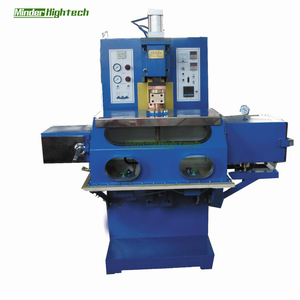
Ultra-precise micro-projection welder optimized for TO-can transistor outlines, optical sensors, and vacuum packaging with controlled atmosphere chambers.
Inquire Now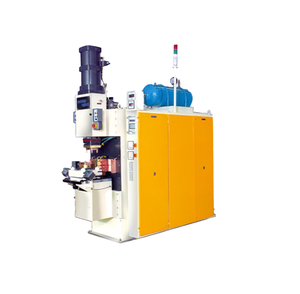
Heavy-duty direct current projection welder tailored for steel sheet components, automotive brackets, structural metal parts, and hardware items.
Inquire Now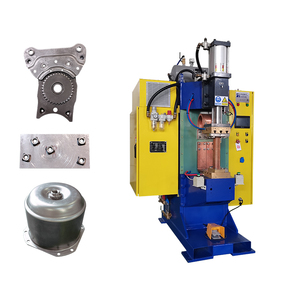
Industrial-grade pneumatic AC projection welder delivering robust electrode force, consistent thermal dissipation, and durable cycle operation.
Inquire Now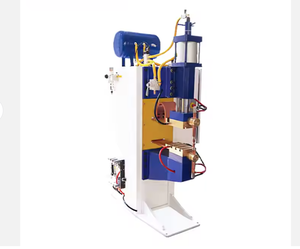
Advanced high-frequency inverter projection machine specifically configured for non-ferrous metals, aluminum plate joints, and bearing core parts.
Inquire Now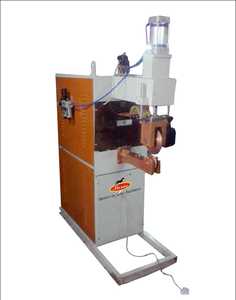
Versatile 110V/220V/380V multi-voltage projection spot welder capable of handling up to 5mm+5mm metal plate thickness with 60kg high-rigidity structure.
Inquire Now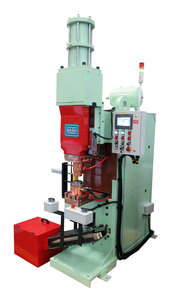
Customizable industrial resistance projection welders equipped with modular power supplies (AC, MFDC, 3-Phase Secondary DC) for structural sheet manufacturing.
Inquire Now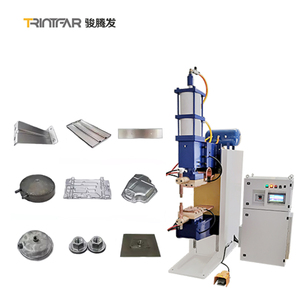
High-power electric resistance welder designed for rapid projection welding of nuts, studs, and heavy gauge stampings with microcomputer digital control.
Inquire Now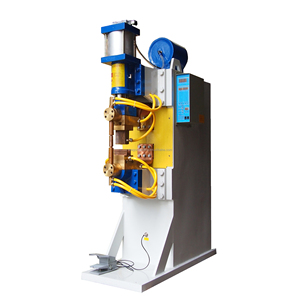
Advanced resistance projection welder integrated with pre-pressing, multi-pulse welding, and post-weld tempering functions for high-carbon and alloy steels.
Inquire NowResistance Projection Welding (RPW) is an advanced evolution of resistance spot welding where current flow and mechanical force are localized at designated embossing points, studs, or projection rings on the workpiece. As a premier CE Certified Projection Welder Manufacturer & Exporter, our engineering design focuses on optimizing Joulean heat generation ($Q = I^2 R t$) at these precise contact nodes. By concentrating current density into high-integrity projections, RPW allows multi-point simultaneous joining, minimal surface discoloration, extended electrode lifespan, and exceptional joint shear strength.
Achieving defect-free projection welds—particularly in high-stress automotive body-in-white (BIW) assemblies or pressurized hermetic packages—requires perfect synchronization between pneumatic or servo-electric electrode force and secondary current pulse timing. During the initial Squeeze Phase, the projection point experiences rapid localized plastic deformation under pre-pressing force. As the secondary welding current ($I_{sec}$) is applied across millisecond intervals, the projection collapses at a controlled rate. If the electrode head inertia is too high, contact separation occurs, causing destructive molten metal expulsion (spatter) and void formation.
Our projection welders integrate guided linear bearings with lightweight alloy rams to ensure instantaneous follow-up force during projection collapse.
Built to EN ISO 12100 & EN 60204-1 standards with dual-channel pneumatic safety valves, light curtain integration, and electromagnetic shielding.
DSP-controlled secondary feedback monitors line voltage drop and dynamic impedance 10,000 times per second to maintain exact energy delivery.
Rooted in over four decades of resistance welding manufacturing expertise (established since 1980 in GIDC Vatva, Gujarat, India), our production facility brings together advanced CNC machining, precision transformer winding, atmospheric braze chamber assembly, and multi-stage CMM validation. As leading exporters, we understand the operational challenges of international industrial manufacturing—ranging from mains power fluctuations to high-duty cycle automation requirements.
| Manufacturing Capability | Standard Market Specification | Our Direct Manufacturer Benchmark | Industrial Value Benefit |
|---|---|---|---|
| Transformer Construction | Class F insulation, standard copper winding | Class H Vacuum-Impregnated Epoxy Cast Copper | Prevents thermal breakdown under 100% continuous duty cycle |
| Frame Structural Rigidity | Welded mild steel angle frame | Heavy-Duty Stress-Relieved Box Girder (60kg+ rating) | Zero arm deflection (<0.02mm) under high pneumatic clamping force |
| Current Control Accuracy | Analog phase-shift control (±10% drift) | Digital Microcomputer / MFDC Inverter Control (±0.5% precision) | Eliminates cold joints and burnt projection burn-throughs |
| Electrode Tooling Material | Standard Class 2 Chrome Copper | Beryllium-Copper (Class 3) & CuCrZr Custom Insert Dies | 3x to 5x longer die life when projection welding fasteners/nuts |
| International Certification | Self-declared local compliance | Third-Party CE Certified (Machinery & EMC Directives) | Seamless import clearance across EU, Americas, Middle East, & Asia |
Whether your operation demands custom pneumatic AC machines for high-speed hardware production or specialized high-frequency inverter systems for structural aluminum component fabrication, our engineered machinery guarantees seamless integration into automated robotic lines or standalone manual stations.
The industrial landscape for metal joining is undergoing a rapid paradigm shift driven by lightweight automotive structural alloys (such as UHSS, AHSS, and 6000-series Aluminum), battery energy storage manufacturing, and high-frequency optical transceiver packaging. B2B procurement teams must align machine specifications with these emerging technology trends to avoid premature equipment obsolescence:
Conventional single-phase AC projection welders suffer from low power factors (0.4–0.6), high peak power draw from the grid, and zero-crossing current delays (every 10ms at 50Hz). Medium Frequency Direct Current (MFDC) inverters rectify three-phase AC input to 1000Hz–4000Hz DC output. This yields a near-unity power factor (0.95+), reduces electrical utility demand by up to 45%, and enables millisecond-level energy injection. MFDC projection welding is fast becoming mandatory for multi-projection weld nut applications and heat-sensitive electronics.
While pneumatic AC projection welders remain the workhorse for cost-effective fabrication, high-precision industrial sectors are shifting toward dynamic Servo-Electric force control. Servo-driven rams allow programmatic multi-stage force profiles—applying low touchdown velocity to prevent projection crushing, high forging pressure during nugget solidifications, and rapid retraction speed for reduced cycle time.
Quality assurance guidelines (such as ISO 14555 and AWS C1.1) increasingly require 100% weld data logging for automotive and structural safety components. Next-generation projection welders come integrated with OPC UA ethernet protocols, logging instantaneous current ($I$), electrode gap displacement ($\Delta m$), dynamic resistance curves ($R(t)$), and total Joulean energy ($J$) for every single weld pulse. Out-of-spec joints trigger automatic pneumatic ejection arms, guaranteeing zero defect escapes.
Looking for a reliable, CE Certified Projection Welder Manufacturer & Exporter for your manufacturing facility? Connect directly with our technical team to receive custom machine sizing, tooling designs, and factory-direct quotation proposals.