Knowledge Hub & Insights
Knowledge Hub & Insights
Engineered for rigorous field construction, municipal infrastructure, high-density polyethylene (HDPE) piping systems, and optical network deployment.
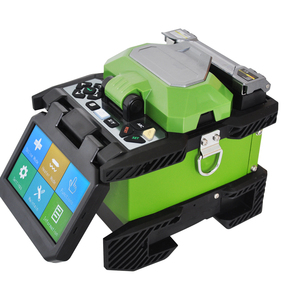
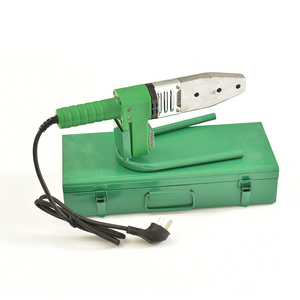
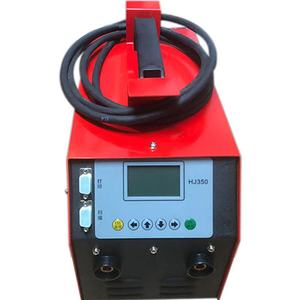
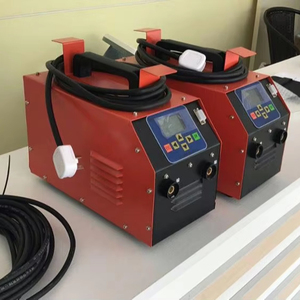
Four decades of continuous innovation in industrial welding equipment manufacturing, export compliance, and field support.
In modern industrial utility deployment—ranging from high-density polyethylene (HDPE PE100 / PE80) gas networks to cross-country municipal water supply lines and fiber-optic telecom backbones—the mechanical integrity of welded joints represents the single critical failure point in pipeline engineering. Fusion welding operates on the principle of intermolecular polymer chain diffusion (for thermopolymers) or atomic lattice coalescence (for metals and optical fibers) under controlled thermal energy and pressure protocols.
As a verified OEM manufacturer established in GIDC Vatva, Gujarat, India, our engineering directives strictly adhere to international quality frameworks, including ISO 12176-1/2 for electrofusion equipment, ISO 21307 for butt fusion parameters, and European CE Directives (Low Voltage Directive 2014/35/EU & Machinery Directive 2006/42/EC). Achieving structural homogeneity across the fusion zone requires advanced electrical waveform stabilization, dynamic ambient temperature compensation, and zero-drift hydraulic pressure regulation.
The technical differentiation between manual socket hot-melt, butt fusion, and modern computerized electrofusion lies in heat application dynamics and pressure curves:
When selecting industrial fusion welding machinery, procurement directors must evaluate technical parameters against site operating environments:
| Fusion Technology | Target Substrates | Voltage & Power Input | Critical Control Factors | Primary Industrial Use Case |
|---|---|---|---|---|
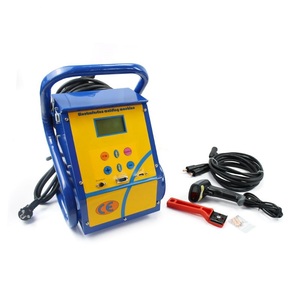
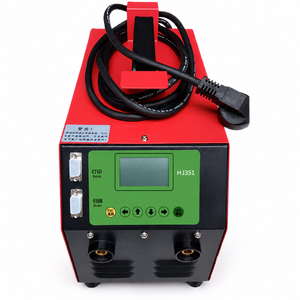
| Electrofusion (Digital) | HDPE (PE80/PE100), PP, PVDF | 220V ±15%, 3.5kW - 6.0kW | Barcode resistance reading, Ambient Temp Sensing | Gas supply lines, high-pressure water mains |
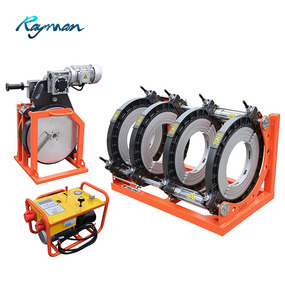
| Hydraulic Butt Fusion | PE Pipe DN40 - DN1600 | 220V/380V, Multi-stage Hydraulic Pump | Drag pressure compensation, Heating plate uniformity | Mining slurry pipelines, municipal sewage |
| PPR Socket Hot Melt | PPR, PE-RT, PB Pipes (20-63mm) | 220V 800W - 1500W | Matrix Teflon coating, Rapid heating recovery | HVAC plumbing, domestic hot water distribution |
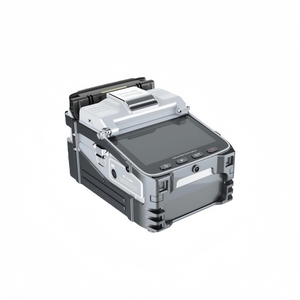
| Optical Fiber Arc Splicer | Single-mode (SM), Multi-mode (MM) | Rechargeable Lithium / AC 100-240V | Core-to-core alignment, Auto arc calibration | FTTH rollouts, 5G backhaul, data centers |
| Automatic TIG Steel Fusion | Carbon Steel, Stainless Steel Tubes | 380V 3-Phase, High-Duty Cycle Inverter | Pulsed current control, Inert gas shielding rate | Boiler tube welding, pressure vessel manufacturing |
Building on over 44 years of manufacturing heritage (Parag Electrodes Agencies Pvt. Ltd.), we combine direct factory pricing with international quality control standards.
Every fusion welding unit is factory-tested under simulated load conditions. We hold complete compliance documentation including ISO 9001 quality management and European CE mark safety compliance.
We provide tailormade engineering solutions, including multi-language UI, specialized barcode scanning software integration, customized input voltage transformers (110V/220V/380V), and private label branding.
Exporting to over 30 countries across the Middle East, Southeast Asia, Africa, and Europe. Our dedicated export logistics team ensures fast sea/air freight handling and seamless customs clearance documentation.
Beyond main fusion welding machines, we manufacture and supply matching pipe scrapers, hydraulic planers, internal de-beading tools, and water-cooling units—providing a complete one-stop procurement source.
Our electrofusion control units feature advanced microprocessors that monitor ambient temperatures from $-10^\circ\text{C}$ to $+45^\circ\text{C}$, automatically calibrating voltage output to prevent under-welding or joint degradation.
Backing every purchase with lifetime technical consultation, remote calibration diagnostics, quick-turn spare parts dispatch, and comprehensive operator training modules for field installation crews.
The global transition toward smart city infrastructure, hydrogen-ready utility pipelines, and fiber-dense 5G/6G communication grids is driving major technological shifts in fusion welder procurement:
A. Cloud-Connected Smart Fusion & GPS Tracking:
Utility operators increasingly demand electrofusion machines equipped with built-in GPS location logging and cellular cloud sync. Modern units record operator credentials, ambient humidity, fusion voltage profiles, and joint coordinates, automatically uploading job logs to cloud quality management systems to meet municipal audit requirements.
B. Inverter-Driven Energy Efficiency & Generator Compatibility:
Field operations often rely on diesel generators with fluctuating voltage outputs. Next-generation electrofusion welders incorporate ultra-wide input voltage tolerance mechanisms ($180\text{V}-260\text{V}$) and Active Power Factor Correction (PFC $> 0.98$), reducing generator fuel consumption and preventing controller board burnouts.
C. Automated Optical Splicing with AI Image Recognition:
In optical fiber fusion, manual core alignment is rapidly being replaced by AI-assisted pattern recognition algorithms. Splicers like the Signal Fire AI-9 series analyze glass fiber end-face angles in real time, automatically clearing micro-dust via plasma arc pre-burn and delivering loss estimation accuracy within $\pm 0.005\text{dB}$.
Technical guidance for engineering buyers, procurement managers, and utility contractor tenders.
Connect with our technical sales engineering team to receive full product catalogs, CE documentation, container freight estimates, and OEM customization options.